How Many Flyers Should I Print? A Simple Formula
Not sure how many flyers to print? Use this guide to land on the right quantity so you don't run out mid-campaign or end up with a garage full of extras.

The most common flyer ordering mistake isn’t choosing the wrong paper or the wrong size. It’s ordering the wrong quantity. Order too few and you run out partway through your campaign, then pay for a small reprint at a higher per-piece rate. Order too many and you’re storing a box of outdated flyers six months later.
Here’s a simple way to avoid both.
A Simple Formula for Estimating Your Flyer Quantity
Start with your distribution method — not a number that feels right. “500 seems like a good amount” isn’t a plan. Here’s how to actually estimate what you need.
First, figure out your reach. Count the households, storefronts, or event attendees you plan to hit. If you’re doing a door-to-door drop across two neighborhoods, look up the actual number of homes. If you’re handing flyers out at a weekend market, estimate expected foot traffic.
Next, add 15% for waste. Flyers get torn, missed, or left behind by accident. Build that in from the start so you don’t run short.
Finally, multiply by your campaign duration. If you want to run the same flyer for eight weeks with weekly drops, your quantity goes up accordingly.
That formula — reach × waste buffer × campaign length — gives you a number you can actually defend when the invoice shows up. It’s also much easier to adjust than a guess you made because 500 felt like a normal amount.
How Many Flyers for Different Types of Campaigns
Different distribution strategies need different quantities.
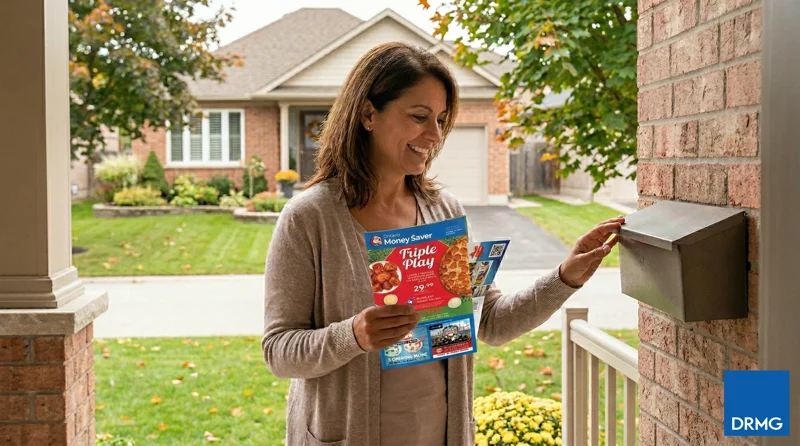
For door-to-door drops, expect to use roughly 150 to 200 flyers per residential street. A focused two-block radius might take 300 total. A broader multi-neighborhood push could need 2,000 or more once you account for every street.
If you’re printing for an event, work off expected attendance and add a buffer for pre-event distribution at nearby cafes, gyms, and community boards. A local concert with 500 attendees might need 650 to 700 flyers total once you account for everything.
For in-store counter displays, 100 to 500 usually covers it. Most businesses cycle through a stack of about 100 flyers over two to four weeks, depending on foot traffic. If you’re in a high-volume retail location, plan on the higher end.
Why Printing More Usually Saves You Money
Per-piece cost doesn’t drop gradually as you order more — it drops in steps. Most print shops offer significantly better rates once you cross certain quantity thresholds. The jump from 250 to 500 pieces can cut your per-piece cost by 20% or more.
With bulk flyer printing, you might spend $45 for 250 flyers and only $65 for 500. That extra 250 costs you $20 upfront — but if you run out and need a reprint, the same 250 flyers could cost $40 or more as a separate short run. You end up paying more to order less.
Understanding how quantity affects flyer printing cost before you order can genuinely change your decision. There’s a real reason most experienced buyers end up ordering a bit more than they initially think they need — the math usually supports it.
What to Do If You Have Leftovers
Don’t throw them away. Leftover flyers are inventory waiting for a different distribution channel.
Drop them at complementary businesses nearby. A gym with extra yoga class flyers can offer them to a smoothie shop or a wellness-focused coffee shop. Leave extras at community bulletin boards, laundromats, or library counters. Hand them out at the next local event you attend.
If the flyer has an expired offer or outdated date, you can repurpose the paper as scratch pads or cut it down into note cards before recycling. But most of the time, leftover flyers still have somewhere useful to go — you just haven’t thought of the right spot yet.
The right quantity starts with a real distribution plan. Know where the flyers are going, add a buffer, and compare prices at a couple of quantity tiers before you commit. It takes ten minutes and saves you from both the reorder scramble and the half-empty storage box.